Alex Rubner
The Export Cult: A Global Display of Economic Distortions
Numéro d'article 10124623
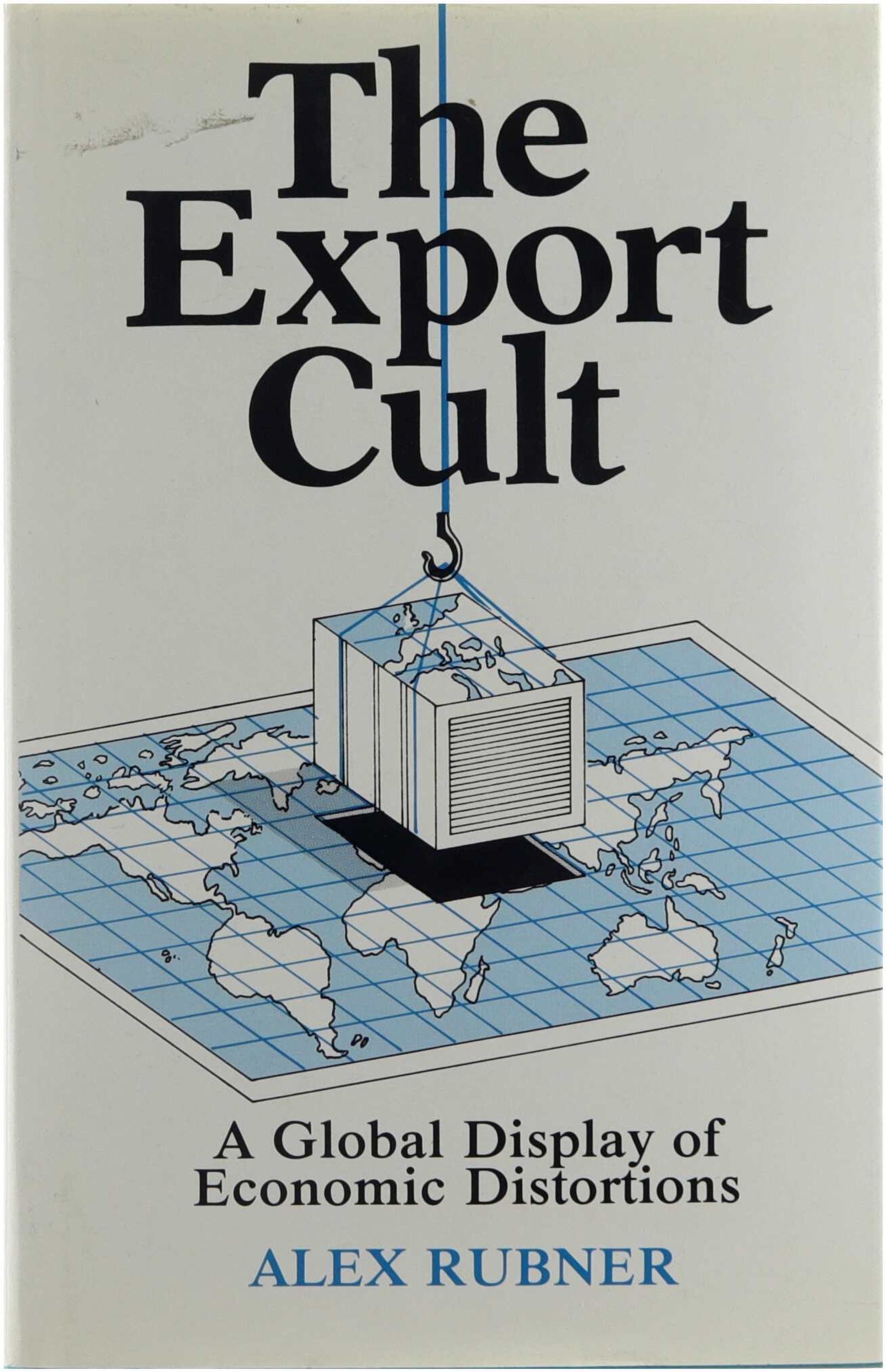
The Export Cult A Global Display of Economic Distortions ALEX RUBNER Politicians of all nations agree that we must export or perish. Many economists know this to be untrue, but that makes no difference. Huge subsidies are provided, extraordinary distortions of the economy are tolerated in the drive by each country to increase its exports at the expense of its rivals. Do we really need to take part in this struggle? Is it a necessity of national survival, or merely a gigantic and harmful charade? Dr Rubner looks at the economic facts. He gives a catalogue of the methods used to boost exports – subsidies, multiple exchange rates, foreign ‘aid’, special insurance deals, interest-free credit, tax exemptions – the list is long and growing, and includes the toleration of bribery and allowance of industrial barons at home to build up mercantile empires abroad. Dr Rubner shows how often all this produces less good than ill. Can countries go on indefinitely as we do now: an economy associated with Britain massively subsidising the building of ships for Poland, whose gross national product is four times smaller? Britain ships go all over the world. The Export Cult also highlights some ingenious devices used to profit from all this folly. (It pays to export crates of bricks or old rags, invoiced as coffee and clocks: such ‘phantom exports’ have made fortunes. Often, too, those who benefit most from export incentives are the largest companies, including the multinationals, which are already highly profitable and whose attempts to gain privileged positions receive special toleration if they can plausibly claim to be furthering the export drive. (One foreign drug firm persuaded the British government to subsidise a new plant at the rate of a quarter of a million pounds for each new job created.) (continued on back flap) Dr Rubner sets out two criteria with which to measure the merits of exports: additionality (it is futile to subsidise exports that would have been made anyway) and VLAD (a particular form of value-added which determines whether the deal profits the exporting country). In general he demonstrates how often it is only the importing country that benefits from subsidised trade; it is just as possible for a country’s level of exports to be too high as too low, and great economic damage is done by failure to understand this. An important section of the book looks at the rationale of exporting and importing in a world of high unemployment and considers the impact of a possible satiation of demand in affluent societies. The Export Cult is distinguished by several virtues. It takes a world-wide view of its subject, drawing evidence from third-world countries as well as from all the major industrial economies – though excluding the Communist world. It brings common sense to bear in a field where it is a scarce resource, and its cogency of economic analysis does not prevent it from being written in a fluent and lively style that makes it not only comprehensible but even a pleasure to read. The Author Alex Rubner is an economic consultant and a well known – and often iconoclastic – writer on economics. As a business economist, he has, among other things, advised international corporations on crossborder issues. He has also lectured in many parts of the world at universities, management seminars and business schools. As a writer, he has published over a thousand articles as well as ten books, among which are The Ensnared Shareholder, The Economics of Gambling, Three Sacred Cows of Economics and The Price of a Free Lunch. Contents Glossary of acronyms Preface Part I THE RULES AND THE TRICKS 1 There is a moral aspect 2 The merits of imports 3 Schacht – the pioneer 4 Britain’s export evangelist 5 Aid for importers 6 Exporters are penalised ‘voluntary’ restraints – foreign politics – neither commercial nor political – the tax motive – to allay domestic shortages – a restriction by multis – to help domestic manufacturers – exchange rate manipulation 7 Some assorted illegalities official figures can mislead – certificates of origin – subsidies under false pretences – the multis and roulette 8 The theory and practice of VALAD gross versus net – value-added at world prices – the modified VALAD is smaller – fraudulent VALAD – governments calculate VALAD 9 The inequality of export-dollars 10 Statistical games exports that return as imports – bigger than the GDP? Part II A CATALOGUE OF CRUTCHES 11 Oblique subventions they are not illegal – multi-purpose subsidies 12 An honest export subsidy 13 Invidious compounds private sector – public sector 14 A benign welcome for foreigners export-related investments – new enterprises – how multis react – takeovers 15 The victimisation of foreigners cartels – close your eyes – product safety 16 Insurance three types of risk – the costs 17 Cheap money subsidised production costs – the administrative funnels – low-interest export credits – the Consensus 18 The abuse of foreign aid some exceptions – how the Consensus is sabotaged – the British temperament – London and Washington retaliate 19 Import Entitlements 20 Tax abatements capital goods – company profits – employees – indirect taxes – window-dressing 21 Miscellanea Part III SOME UNPALATABLE CONSEQUENCES 22 Barren exports brains – machinery – export-induced imports 23 Devaluations the manipulators – profits or volume? – certain exports are bad 24 Domestic demand general policies – specific targets – inconsequential? 25 Inflation 26 Capital goods three fiascos – a culpable infatuation – a chink of light 27 The scourge of countertrade in many shapes and forms – the performers – a wicked subterfuge Part IV HERETICAL FORMULAE 28 There are alternatives other options: benefactions; imports; gastarbeiter; crossborder investments; services; tourism; internal exports – are invisible exports candy-floss? 29 We are entitled to know 30 Free trade and full employment 31 Free trade and no full employment ‘jobless growth’ – the reduced demand for labour – partial cures – why Free Trade? – the unfamiliar Keynes – occupational therapy Part V SUPPORTING MATERIAL Appendix 1 The swapping game 2 The astute Poles 3 Exports sanctify mergers 4 The textile-dollars of Colombia 5 Barbara Castle 6 The Republic of Ireland four pillars – a paradise for the multis – VALAD does matter 7 Export salesmen 8 The royal bestowal of praise 9 Business entertainment 10 Company reports Cited sources Index
État
D'occasion - Très bon
Langue
Anglais
Type d'articles
Livre - Couverture rigide
Année
1987
EAN
9780566052200
Jaquette
Très bon