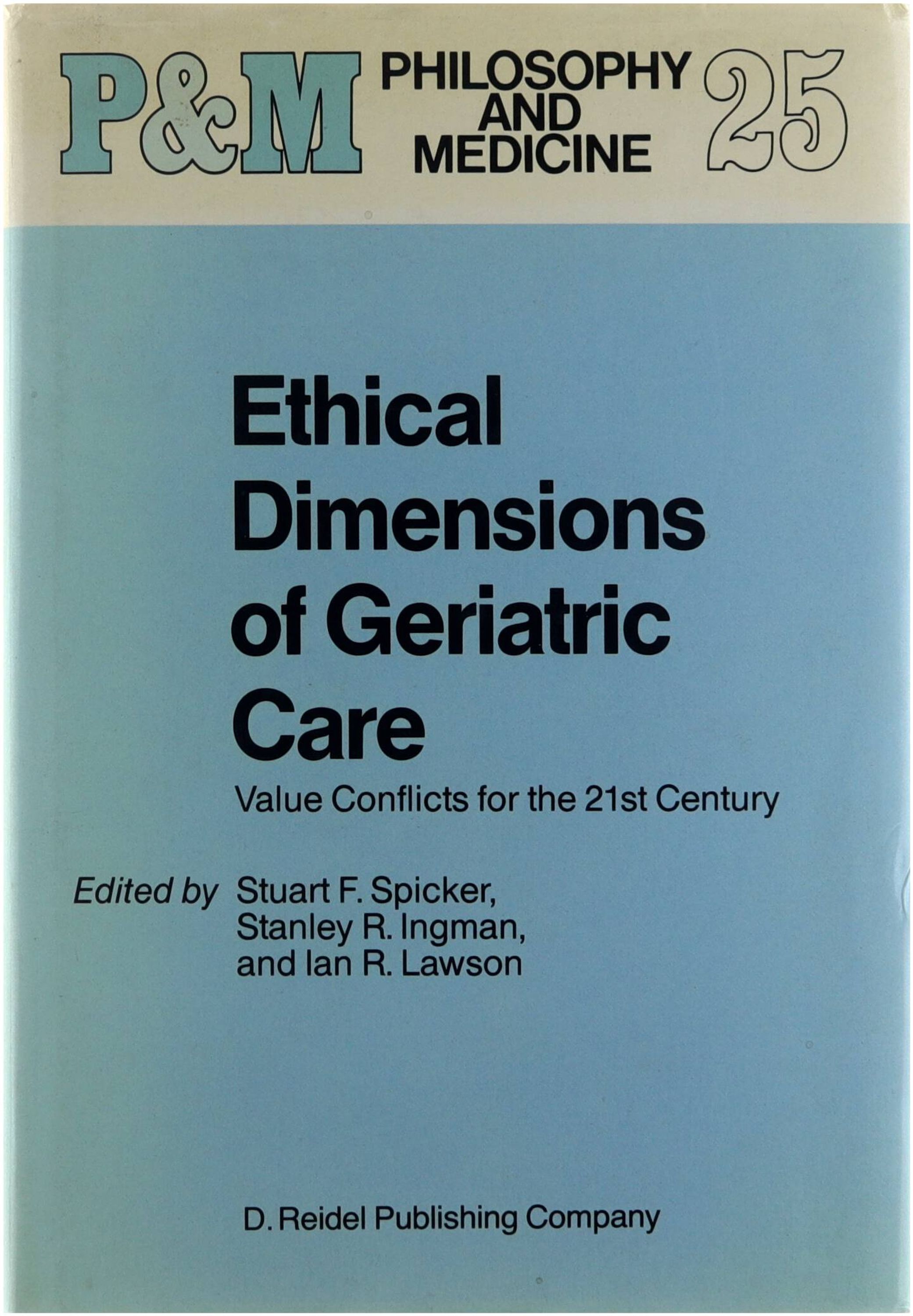
Spicker Stuart F. Ingman Stanley R. Lawson Ian R.
Ethical dimensions of geriatic care, value conflicts for the 21ste Century (Volume 25)
Numéro d'article 10124392
Ethical Dimensions of Geriatric Care: Value Conflicts for the 21st Century. Edited by Stuart F. Spicker (School of Medicine, University of Connecticut Health Center, Farmington, Connecticut, U.S.A.), Stanley R. Ingman (Dept. of Family and Community Medicine, University of Missouri at Columbia, U.S.A.) and Ian R. Lawson (School of Medicine, University of Connecticut Health Center, Farmington, Connecticut, U.S.A.). This 25th volume in the Philosophy and Medicine series is devoted to numerous ethical and value conflicts involved in the clinical care of the aged and very elderly at the stage of transition to the 21st century. The work pays special attention to the U.S. experience but is also pertinent to a wider variety of disciplines: geriatric, internal and psychiatric medicine; nursing, medical sociology, political science, health law, journalism, public health, ethics and moral philosophy. The volume focuses on four themes: (1) understanding the biology and epidemiology of aging; (2) philosophical reflections on medical care provision for the aged; (3) self-determination in late-life dependency; (4) justice in the provision of medical care for the aged. The book ends with an epilogue on the transition to the eighth stage of humanity: the prosthetic era. D. Reidel Publishing Company, Dordrecht/Boston/Lancaster/Tokyo. TABLE OF CONTENTS — Richard W. Besdine, M.D./Foreword (vii). Editors' Preface (ix). Richard A. Lusky, Stanley R. Ingman, Stuart F. Spicker and Ian R. Lawson/Introduction (xiii). Editors’ Acknowledgement (xxxiii). Section I: Understanding the Biology and Epidemiology of Aging — Jacob A. Brody/The Best of Times – The Worst of Times: Aging and Dependency in the 21st Century (3). Tom Beauchamp/Commentary on Jacob A. Brody’s Essay (23). Albert Rosenfeld/Changing Images of Dependency in Prolongevity (29). Randolph Martin Nesse/An Evolutionary Perspective on Senescence (45). Section II: Philosophical Reflections on Medical Care Provision for the Aged — Daniel M. Hausman/Health Care: Efficiency and Equity (67). Baruch Brody/Wholehearted and Halfhearted Care: National Policies vs. Individual Choice (79). Thomas Halper/Commentary on Baruch Brody’s Essay (95). Teo Forcht Dagi/Revival, Resuscitation, and Resurrection: The Rights of Passage (105). Section III: Self-Determination in Late-Life Dependency — Molly Rees Gavin and Gayle Kataja/Self-Determination in Later Life: Case Studies in Geriatric Care (129). Nancy Neveloff Dubler/The Dependent Elderly: Legal Rights and Responsibilities in Agent Custody (137). Margaret P. Battin/Choosing the Time to Die: The Ethics and Economics of Suicide in Old Age (161). Joseph M. Healey/Elderly Dependency and Autonomy: Comments on the Essays of Dubler, Battin, Kataja and Gavin (191). Section IV: Justice in the Provision of Medical Care for the Aged — Norman Daniels/Equal Opportunity, Justice, and Health Care for the Elderly: A Prudential Account (207). Stanley R. Ingman, Jack Ferguson, and Lynn Campbell/ESRD and the Elderly: Cross-National Perspective on Distributive Justice (223). H. Tristram Engelhardt, Jr./The Bad, the Ugly, and the Unfortunate (263). Epilogue: The Eighth Stage of Humanity — Ian R. Lawson/Elderly Dependency and Systems Failure: Obstacles to a Prosthetic Society (273). Notes on Contributors (291). Index (293). Review — “The editors have brought together in one volume a wide range of disciplines on a topic of growing importance. Ethics is rightly located in a socio-historical context, and the myth that ethical principles can be meaningful apart from their social context is dispelled as one reads the essays. The contributors illuminate ethical dilemmas from two philosophical and ideological poles – the dominant American perspective or ideology of individualism and the more European tradition of collectivist thought. The work provides some surprises for the reader. One essay on suicide and the aged may even startle some academics, since one author suggests that suicide in old age could conceivably become the accepted moral decision in societies where the collectivity has decided not to provide adequate care of the so-called frail aged. There is no doubt about the relevance and significance of these topics to social and health policy for the aged. This volume should be read by academicians and clinicians alike who work in health and aging.” — Professor Carroll L. Estes, Director, Institute for Health and Aging, University of California, San Francisco. D. Reidel Publishing Company, Dordrecht/Boston/Lancaster/Tokyo.
État
D'occasion - Bon
Langue
Anglais
Type d'articles
Livre - Couverture rigide
Année
1987
Éditeur
Boston
EAN
9781556080272
pp. 297